
Heterobasidion annosum, otherwise known as conifer root and butt rot, is a basidiomycete fungus that invades and rots tree roots, butts, and stems (Greig, 1981).
Initial infection of a forest stand with Heterobasidion annosum occurs when its airborne basidiospores contact freshly cut stem surfaces (Hibberd, 1991).
However, once an initial infection event has occurred, root to root contact between infected stumps and neighbouring softwoods means that the fungus can rapidly spread throughout stands once established.
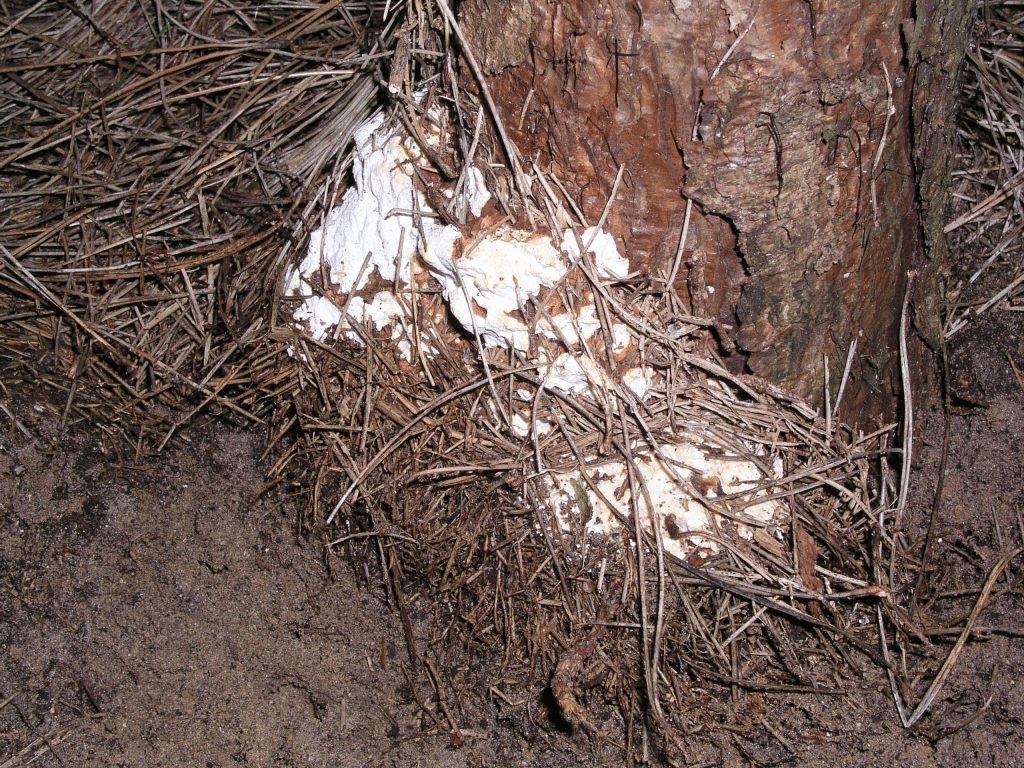
Heterobasidion annosum primarily affects non-native commercial conifer species in the UK, but also decays the native Scot’s pine (Hibberd, 1991). Broadleaves are occasionally affected (Greig, 1981).
The butt rot that Heterobasidion annosum causes leads to a greater likelihood of windthrow, due to the structural damage caused at the stem base. The fungus itself may even outright kill younger trees (Hibberd, 1991).
If a stem remains upright despite the structural damage at its base, high quality stem wood has been lost regardless, due to the rot extending several metres from the stem base (Hibberd, 1991).
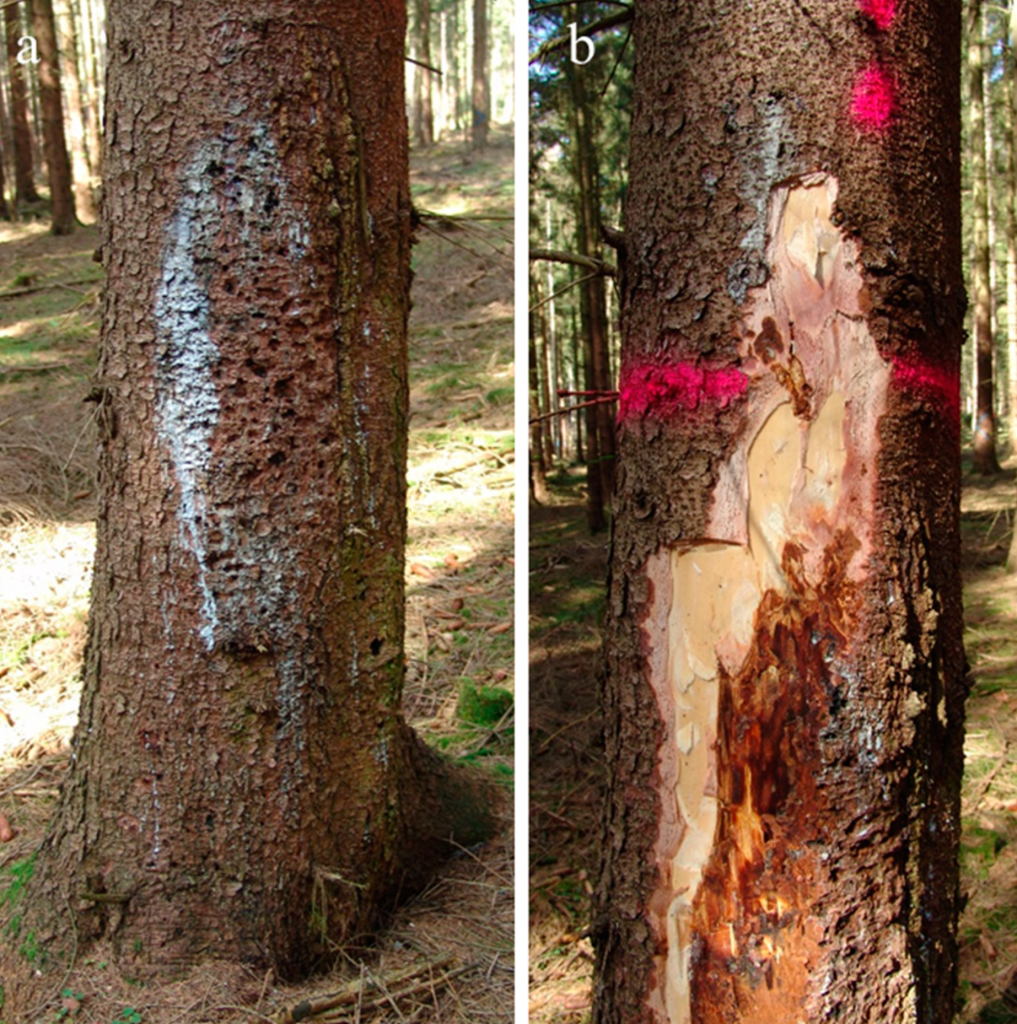
Continental European softwood industries have suffered greatly due to Heterobasidion annosum, especially those dominated by Norway spruce (Forest Research, n.d.).
The fungus does not affect UK forestry as severely as it does continental Europe’s, though preventative measures remain important in commercial forestry (Forest Research, n.d.)
Prevention is highly important, as if another rotation is attempted on an infected site, the infection of young trees will be rapid, due to Heterobasidion annosum persisting between rotations (Hibberd, 1991).
Because of this, Heterobasidion annosum primarily affects second rotation sites (and following rotations), rather than first rotation sites; however, if thinning occurred in a site’s first rotation, it may be affected (Greig, 1981).
Once an airborne infection event has occurred, UK plantations are just as vulnerable to Heterobasidion annosum as continental Europe is.
Therefore, routine control measures are commonly taken against the fungus to reduce its abundance, and thus reduce its rate of spread, in the UK (Hibberd, 1991).
Traditionally, the most common control measure against Heterobasidion annosum was for chainsaw operatives to urinate upon their freshly cut stumps.
This method was effective, as are modern urea treatments, though the application method was obviously limited in scale and convenience (Oliva et al., 2008).
In British commercial forestry, urea-based chemical treatment of freshly cut stumps remains the most common form of infection prevention, accounting for 90% of treatment against Heterobasidion annosum (Forest Research, n.d.).
This treatment is highly effective and practical for foresters, although is considered somewhat undesirable due to increasing apprehension towards applying chemical controls to ecosystems, due to the resulting effects on water and soil quality (Forest Research, n.d.).
In lieu of chemical treatment, Phlebiopsis gigantea is sometimes applied to fresh stumps as a form of biological control against Heterobasidion annosum.
However, this preventative practice is less popular in the UK than chemical treatment (Forest Research, n.d.).
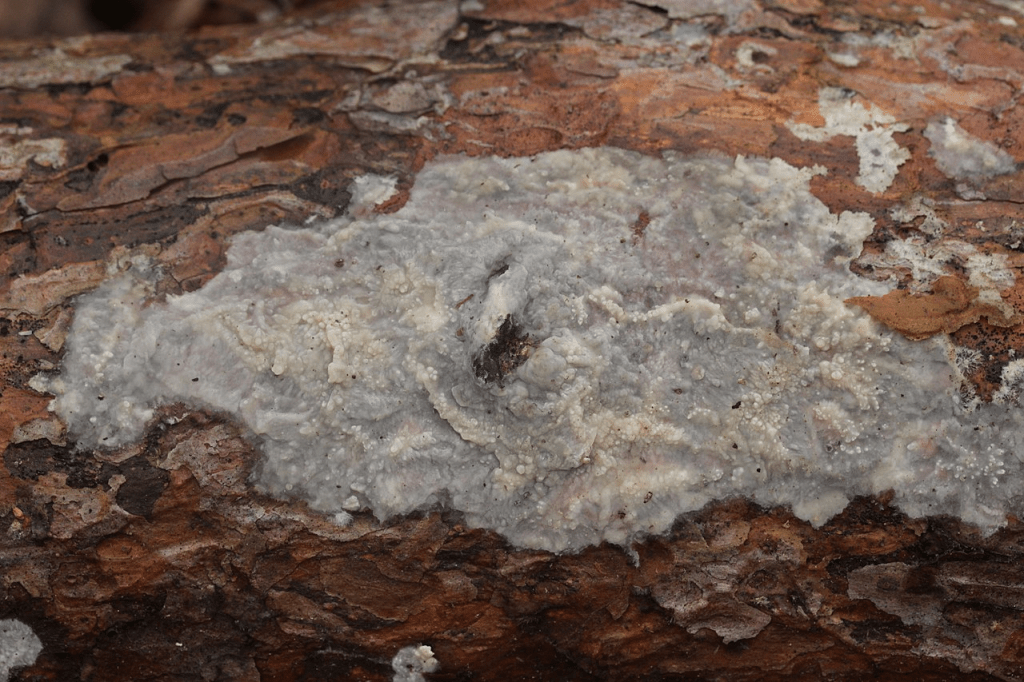
Low uptake of biological control methods is likely due to practical implementation in Scandinavia proving unsuccessful.
This was not due to the treatment itself being ineffective, however. It was due to the application of the PG solution treatment by practicing foresters being incorrect (Blomquist et al., 2023).
Thus, where chemical treatment is deemed undesirable by stakeholders, biological control is possible. However, it would require the improved education of practicing foresters on its correct usage (e.g. via the production and distribution of technical guides) to be effective.
Overall, it is recommended that forest managers remain vigilant to the threat of Heterobasidion annosum, with preventative measures against it being especially important in commercial forestry contexts.
Timely application of treatments after felling operations, whether urea-based or otherwise, protects the treated stand effectively, and also protects the UK forestry industry as a whole, due to reducing the abundance of airborne basidiospores throughout the country.
Bethany Breward.
04/05/2025.
References
Blomquist, M., Cleary, M., Sherwood, P., Pinto, W., Sebastian Larsson Herrera, Marčiulynienė, D., Elsafy, M., Bakal, I., Nilsson, A. and Rönnberg, J. 2023. The potential of biological control against Heterobasidion root rot is not realized in practical forestry. Forest ecology and management. [E-journal]. 531. Available at: https://doi.org/10.1016/j.foreco.2023.120778. Accessed 4th May 2025.
Björn, S. 2018. Phlebiopsis gigantea. [Photograph].
Forest Research. n.d. Conifer root and butt rot (Heterobasidion annosum). [Online]. Available at: https://www.forestresearch.gov.uk/tools-and-resources/fthr/pest-and-disease-resources/conifer-root-and-butt-rot-heterobasidion-annosum/. Accessed 4th May 2025.
Greig, J.W. 1981. Decay Fungi in Conifers. Edinburgh: Forestry Commission.
Hibberd, B.G. 1991. Forestry Practice: Handbook 6. 11th edition. London: Forestry Commission.
Oliva, J., Samils, N., Johansson, U., Bendz-Hellgren, M., & Stenlid, J. 2008. Urea treatment reduced Heterobasidion annosum s.l. root rot in Picea abies after 15 years. Forest Ecology and Management. [E-journal]. 255(7), pp.2876–2882. Available at: https://doi.org/10.1016/j.foreco.2008.01.063. Accessed 4th May 2025.
Terhonen, E., Langer, G., Bußkamp, J., Rӑscuţoi, D., & Blumenstein, K. 2019. Resin flow on the stem is one of the symptoms that indicates the possible infection of H. annosum s.l. Living Norway spruce, confirmed to be infected by Heterobasidion annosum s.l. [Photograph]. Forests.
 Forests in Theory
Leave a comment