
Why create a forest management plan?
There are many reasons to create a forest management plan (FMP). For example a documented FMP is typically needed to:
- Receive woodland grant funding (though this is not always necessary in Northern Ireland).
- Achieve forest certification.
- Maintain continuity of management for prolonged periods of time.
Despite their importance, many land managers do not have a formally documented forest management plan. This may be because the formal documentation of a FMP can be an unpleasant exercise in the short-term.
However, forward-thinking is rewarded in the inherently long-term industry of trees. Thus, learning to create a high quality FMP is an essential skill for effectively engaging with a woodland.
How to create a forest management plan
In general, the complexity of a FMP should match the complexity of the operation and objectives.
The conventions of a FMP vary somewhat within in the UK. For example, in Scotland they are called “land management plans” due to having an increased consideration of non-forest land uses present on site (Forestry and Land Scotland, 2025).
However, the basic steps of creating a FMP remain the same throughout the UK overall.
Step 1: Resource Assessment
Before you can plan what you want from your woodland and how to get there, you need to know the woodland’s current assets, condition, and the influences that work upon it.
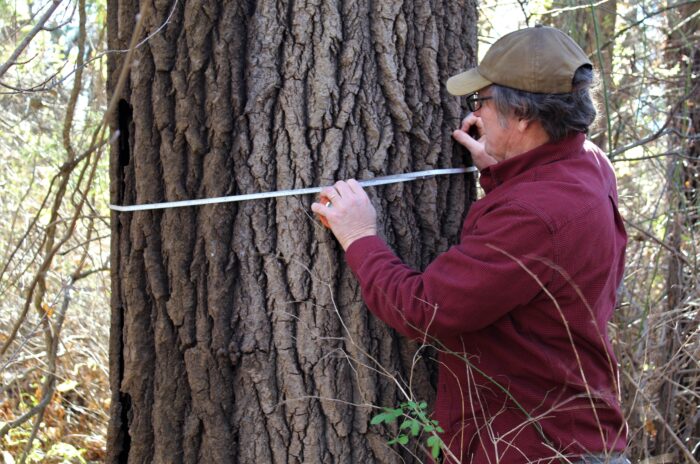
Depending upon the resources available to you as a woodland manger, either a basic or full forest inventory should be conducted.
Example criteria to consider when inventorying a woodland include: tree species, height, DBH, age, density, wildlife habitats, soil, water resources, and ecological conditions.
Step 2: Stakeholder Engagement and Analysis
Don’t just engage statutory consultees!
Engaging the local community in the creation of a FMP often reduces the likelihood of anti-social behaviour in the woodland, due to the increased buy-in to its management (Hodge, 1995).
Stakeholder engagement is therefore especially important in urban woodlands.
Step 3: Objective Identification
Define your objectives. Objectives should be feasible, specific, and have measurable indices of achievement.
Step 4: Formulation of Management Strategies
Identify what silvicultural and management approaches are needed to achieve objectives.
Note: to receive grant funding from government bodies, any management strategy must be UKFS compliant (Forestry Commission, 2025).
Step 5: Zoning and Land-use Planning
Conflicting land-uses may need to be reconciled if the site has multiple objectives. Thus, designating different areas of the woodland for different uses is ideal.
Activity buffer zones will be needed around sensitive areas of the site, such as watercourses, historical features, and protected species habitats (UKFS, 2023).

Step 6: Implementation and Operations
Once the plan is made, it must be implemented!
The FMP itself must be UKFS compliant, as must its implementation. The minimum level of adherence is legal, but good practice guidelines should also be followed (Forestry Commission, 2025).
Regular checks to ensure the plan is being adhered to are especially important where contractors are being utilised.
Step 7: Monitoring and Evaluation
In order to assess the effectiveness of a FMP in meeting its identified objectives, formal measurements should be conducted.
For example, where recreation is an objective, measurements of visitor numbers and satisfaction should be made.

Management should be adapted based on the results of measurements.
Step 8: Review and Revision
Review and revise the FMP based on future issues, extenuating circumstances, and new and changing woodland management objectives.
Using templates
Thankfully for woodland managers, these 8 steps can easily be followed using a pre-made FMP template.
FMP templates can be found at: https://www.gov.uk/guidance/create-a-woodland-management-plan
So long as it’s understandable to potential auditors, it is also acceptable to create your own template.
To conclude…
Following these 8 steps and using the correct template will create professional appearing and practical forest management plans.
This plan is an important document, so take good care of it, and make sure to review and update it regularly.
Thanks for reading,
Bethany Breward
28/05/2025
References
Dresh, C. 2021. Male great crested newts have a striking jagged crest running down their spine. [Photograph].
Forestry and Land Scotland. 2025. Active Land Managements Plans. [Online]. Available at: https://forestryandland.gov.scot/what-we-do/planning/active. Accessed 27th May 2025.
Forestry Commission. 2025. Woodland Creation Planning Grant. [Online]. Available at: https://www.gov.uk/guidance/woodland-creation-planning-grant#find-out-if-youre-eligible. Accessed 27th May 2025.
Hodge, S. 1995. Creating and Managing Woodlands Around Towns. London: HMSO.
Martin, K. 2022. [Photograph].
UKFS. 2023. The UK Forestry Standard: The government’s approach to sustainable forestry. [Online]. Forest Research, Farnham.
 Forests in Theory
Leave a comment