
Taking high-quality field notes is a vital skill for forestry students, researchers, hobbyists, and managers alike.
Despite this, field notes have an awful tendency towards ending life as soggy messes at the bottom of backpacks.

To counteract problems such as this, here are 5 tips for improving your note-taking in the field!
Tip 1: Bring the right equipment
If you’re working in the field, especially the British field, then expect rain to land on your note-taking system.
For paper notes, investing in a waterproof notebook is advisable. They are relatively cheap, and will prevent the prior- mentioned soggy paper in the backpack predicament.
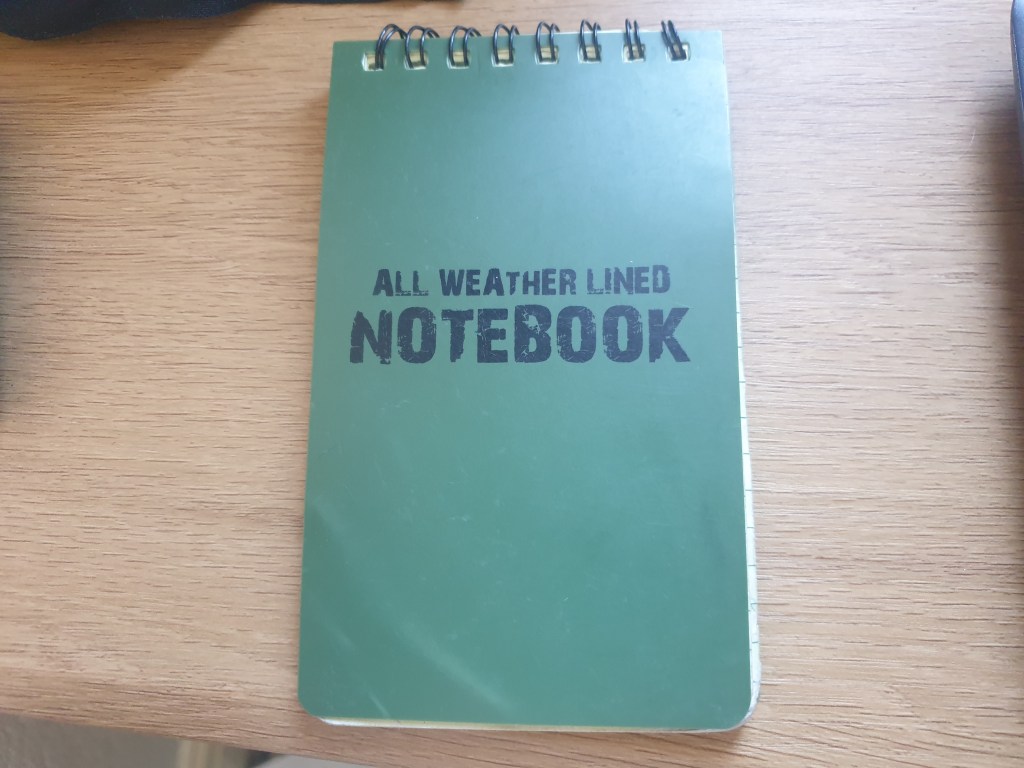
As a quick reminder to readers, just because the paper is waterproof, doesn’t mean the ink is. Therefore, you should use either a pencil or waterproof ink with your waterproof notebook.
If you prefer taking notes on your mobile phone, rain may scramble the touchscreen sensors. Therefore, taking “audio notes” using the phone’s microphone may be preferable.
Plastic bags are a cheap way to waterproof your tech, and can also be used to protect paper notes in your backpack. It’s not single-use plastic if you re-use it!
Tip 2: Wear the right clothes
When working outdoors, wear many layers (as opposed to wearing only 1 or 2 bulky layers).
Depending upon forecasted weather conditions, bringing cool, waterproof, and warm fleece layers allows you to continue to take high-quality notes in adverse weather conditions.
After all, you aren’t going to be jotting down the species composition of the forest understorey if you are succumbing to hypothermia.

Tip 3: take photographs and sketches
Photographs and sketches are a great way to record visual aspects of the landscape.
Good photos and sketches don’t just jog your memory of the day. They can also supplement and improve your field notes in their own right.
Having a dedicated photo album for fieldwork can also be a handy way to refer back to past work for learning or marketing purposes.
Just make sure to record where photos and sketches were taken!
Tip 4: stay organised
For electronic notes, staying organised can be as simple as titling them, dating them, and then saving them in a dedicated folder.
For paper notes, make sure that they aren’t left strewn around the office. That’s how scrap paper is made.

Instead, have a dedicated “field journal”. This field journal can be a waterproof book, folder, or paper tray.
Whatever form it takes, field notes go into this journal ASAP. This will prevent them from getting lost.
Just make sure to not lose your field journal…
Tip 5: Back-up your field notes
When it comes to storing your fieldwork data, safety first!
If taking physical notes, scan them in to digitally save them.

Remember, a digital copy isn’t just a back-up. Digital is also the ideal format for sharing your findings with others!
For electronic notes, a USB stick works, but is considered somewhat antiquated nowadays.
Instead, cloud storage is the more workplace-friendly option, allowing for multiple people to edit the same document at the same time.
No matter how you elect to back-up your work, just make sure that you do it regularly!
Thanks for reading,
If you’ve got a tip that wasn’t mentioned here, leave it in the comments!
Bethany Breward, 12/06/2025.
 Forests in Theory
Leave a comment