
Today’s Forests in Theory is the first of the new Future Threats to Forests series.
To create this series, I will release a deep dive article about one threat to UK forests once a month, every month.
Whilst the focus of the series will predominantly be on threats to UK forests, important case studies from other countries will be drawn into the mix too.
To note is that this series plans to be highly-reader led. Thus, if there’s a topic you’d like covered that we haven’t got around to, then leave it in the comments!
Pine processionary moth (Thaumetopoea pityocampa)
This month’s Future Threat to Forests is pine processionary moth.
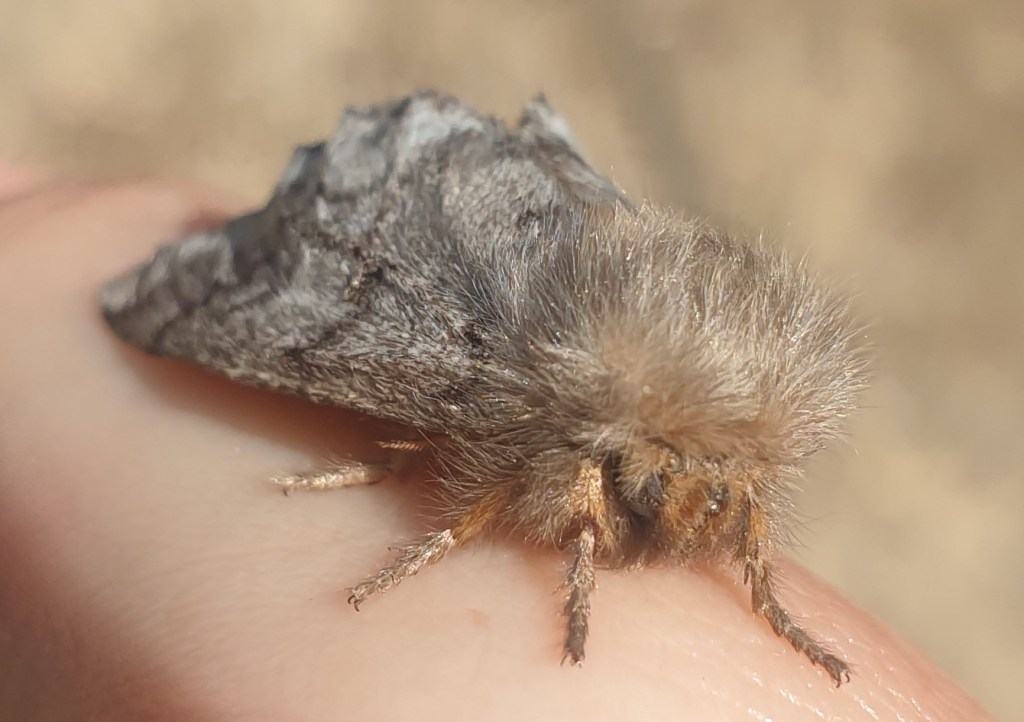
Pine processionary moth (Thaumetopoea pityocampa) is considered a non-native pest species in the UK.
Whilst it is currently very rare in the UK, with only single individuals and transient populations having been officially recorded, pine processionary moth (PPM) poses a considerable risk to tree health, especially pine species. This is because in high densities, PPM larvae may severely defoliate affected trees (Forest Research, n.d.).
PPM larvae (caterpillars) are also a threat to human health, as they contain poisonous proteins that are harmful to animals and young children when ingested, and also cause skin irritation. (Dawber, 2016) (Bonamonte et al., 2013).
Whilst native to southern Europe, North Africa and parts of the Middle East, PPM is noted to be migrating northwards, with populations having been reported as far north as Paris.
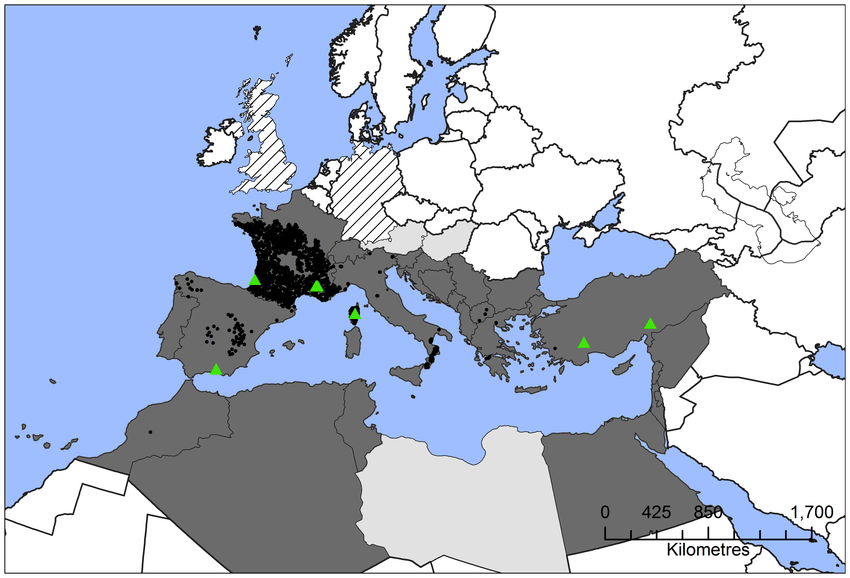
Black circles indicate known locations for PPM, green triangles are locations from which impact data has been reported. Dark grey shading indicates that PMM is reported regularly, light grey shading indicates that PPM is seldom reported, cross-hatching indicates that PPM’s presence is unknown, and white indicates that PPM is absent.
Due to its northern migration, UK forest managers, traders, and government bodies are currently working to prevent the establishment of a stable breeding PPM population in the UK.
For example, in 2022, the British government deemed the likelihood and risk of PPM introduction so high, that emergency legislation restricting the movement of pine and cedar trees into Great Britain was passed (DEFRA, 2022).
This legislation states that cedar and pine trees can only be imported into the UK from approved countries and/or nurseries. To gain approval, the exporting country either has to have been confirmed as PPM-free by the National Plant Protection Organisation, or be confirmed as wholly pest free in general. An additional third exception states that, so long as the trees were grown be an approved nursery, the exporting country can be affected by PPM.
As of August 2025, this legislation is still in place.
The nursery exception means that, so long as “the trees have been grown under complete physical protection for their lifetime“, they can be imported from countries with PPM populations.
This exception, whilst useful for UK planting efforts and best practice tree nurseries alike, could be a viable avenue for the introduction of PPM into the UK.
Just because a tree has been grown under complete physical protection, which itself may not be true, it being free of PPM is not guaranteed.
For example, when importing live plants, PPM larvae may unknowingly be hidden in the tree’s growing medium. Due to nursery’s plant hygiene measures, this situation is rare, but it only has to happen a few times for a stable PPM population to be introduced into the UK.
Furthermore, alongside trade-based movement, the adult moths frequently fly northward, further reducing the geographical barrier between PPM and the UK!
Therefore, whilst the 2022 legislation was a significant preventative measure, UK forest managers and ecologists, especially those Southern England, should learn to recognise PPM, in both its larval and adult form.
Recognising pine processionary moths
For the average forest enthusiast, it can be difficult to distinguish pine processionary moth from oak processionary moth (OPM). Fortunately, if you spot either in your forest, it’s bad news either way.
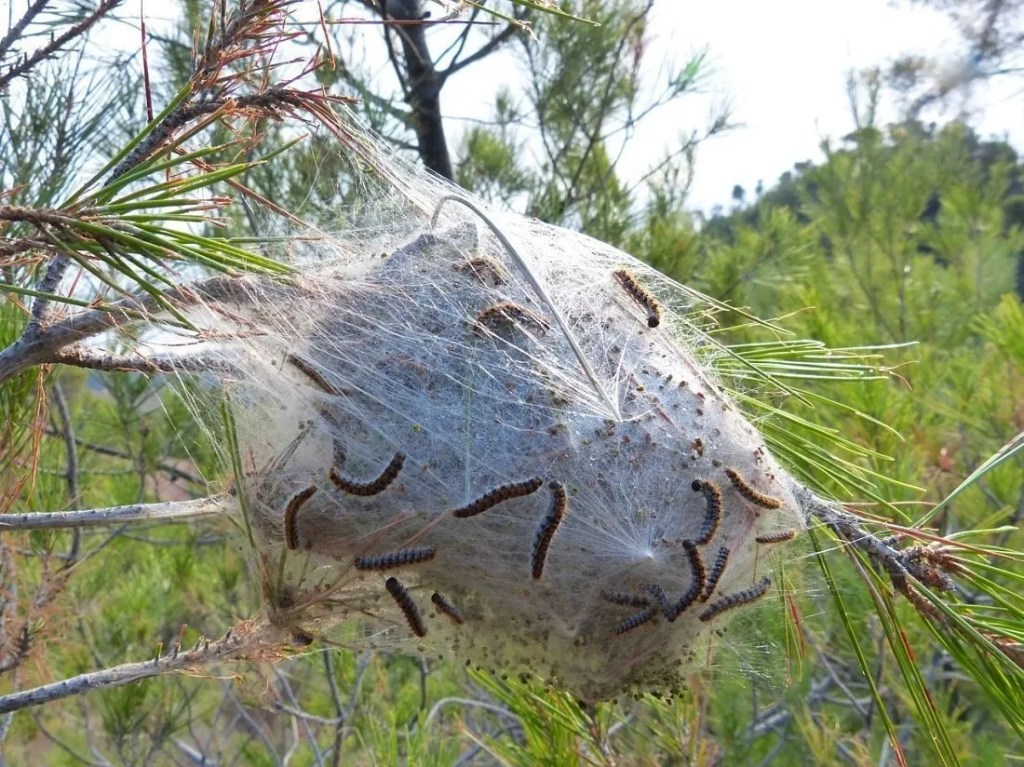
Forest Research recommends that to distinguish PPM caterpillars from OPM caterpillars, look at what tree they’re feeding on. If it’s an oak or other broadleaf species, they’re likely OPMs. If it’s a pine or other conifer species, they’re likely PPMs.
Additionally, observe the caterpillars marching habit. All processionary caterpillars march in nose-to-tail processions (hence the name), but PPMs are more likely to march in single file, whereas OPMs typically form a more triangular procession (Forest Research, n.d.).
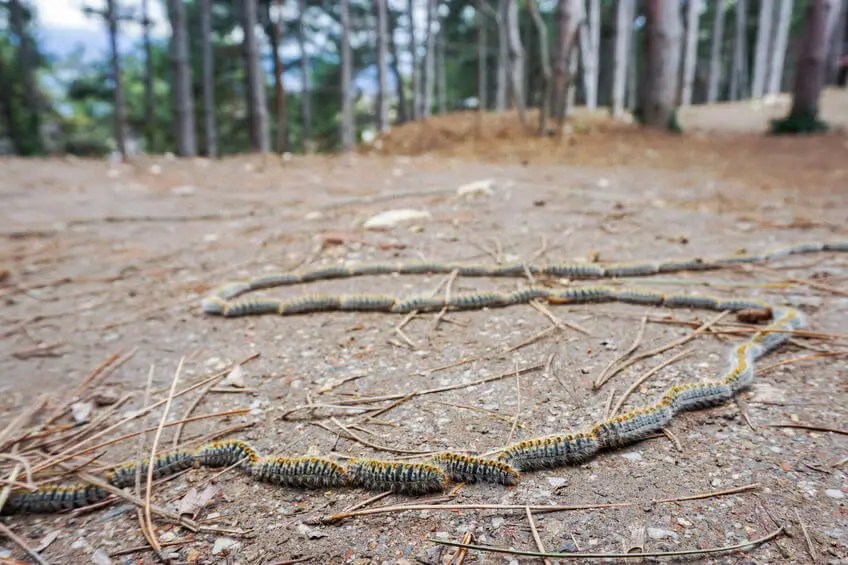
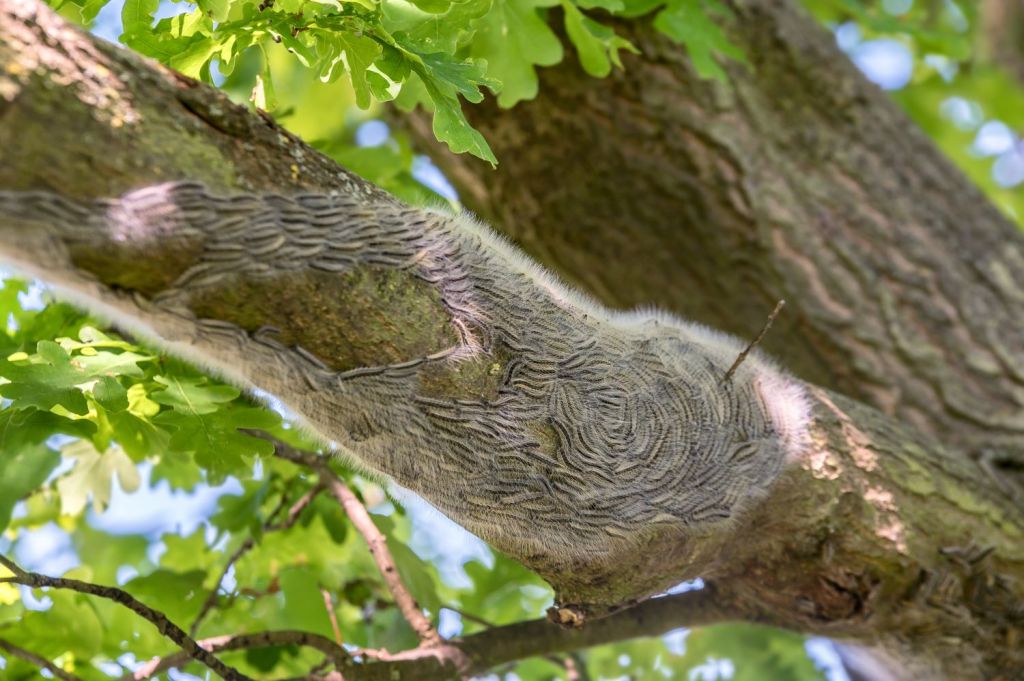
Unfortunately, as the caterpillars primarily emerge at night (i.e.. when its dark and you’re not there) you’re likely to not see them. Thus, look out for the white silken nests that they build amongst the foliage instead.
Once the moths have pupated, they will emerge as adults from May-July. Distinguishing PPM adults from OPM adults is tricky but if you’d like to try, then consider the time of year that the adult moth emerged.
If it emerged May-July, it’s likely a PPM. If it emerged June-August, it’s likely an OPM. These emergence times overlap considerably, thus, identifying the moths before they’ve pupated is ideal.
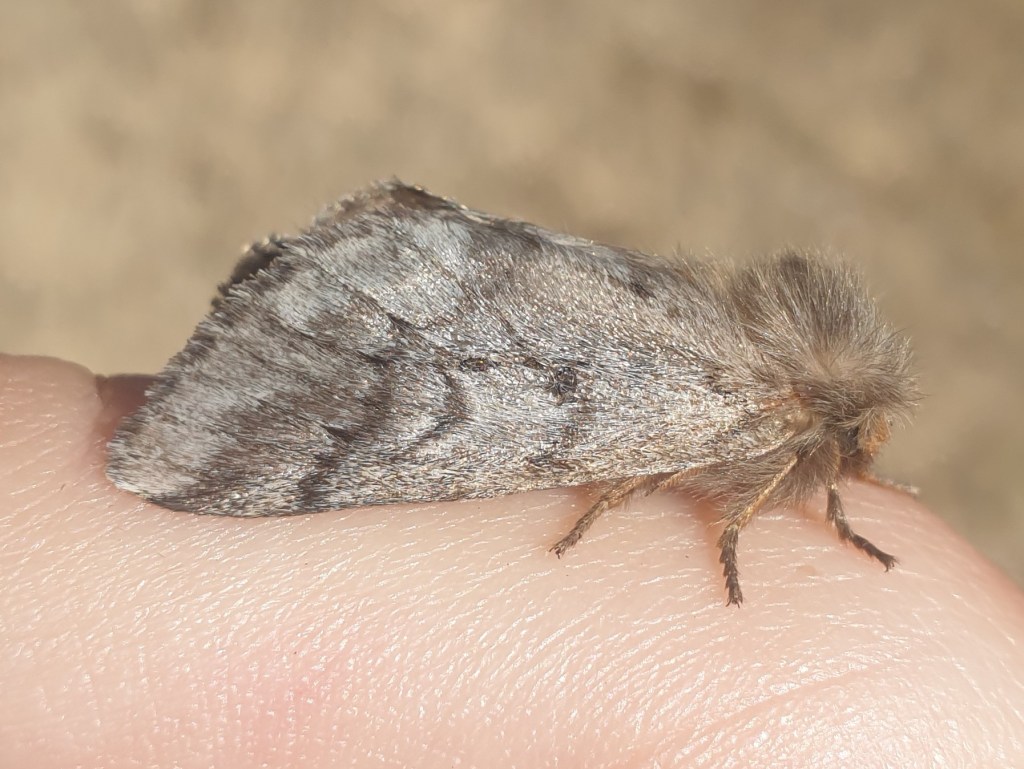
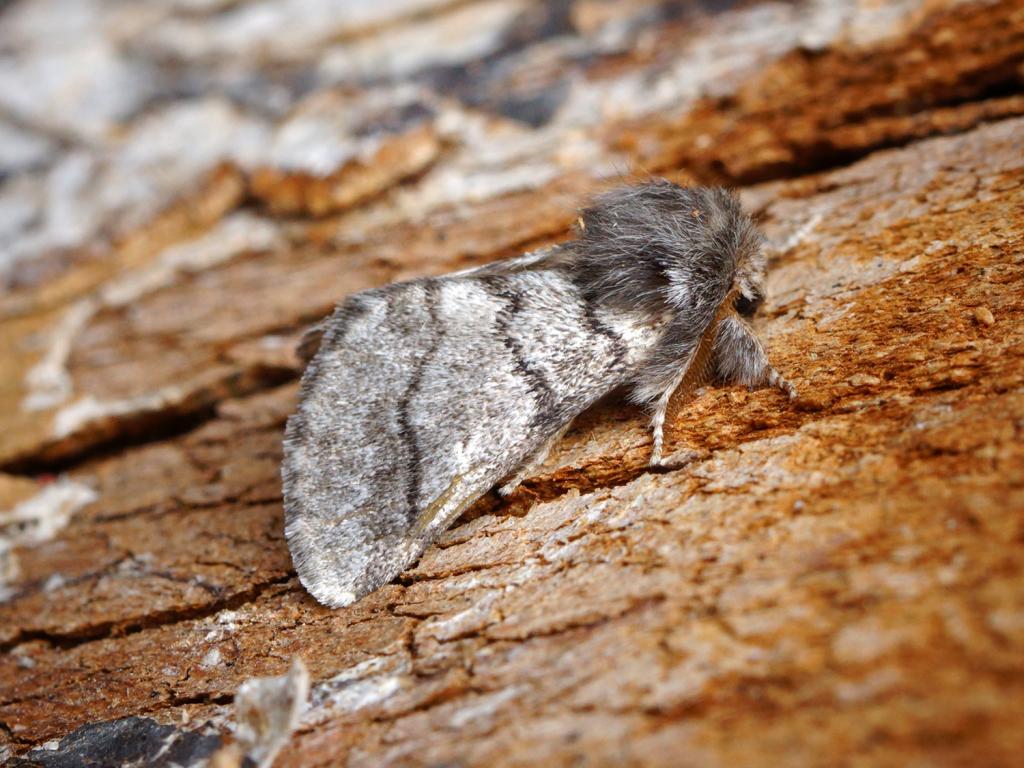
Overall, it’s a lot easier, and better, if you attach a clear photo alongside your processionary moth observation when you report it. That way, Forest Research can ID it for you!
Conclusion
Due to its trade-assisted northward migration, pine processionary moth will likely be a threat to Britain’s forests in the near future.
Thus, forest managers and ecologists, especially those based in the south of England, should be on the lookout, and report suspected PPM sightings via TreeAlert.

To prevent PPM infestations on an individual level, forest managers can maintain good plant hygiene, and not import ‘dodgy‘ tree stock for planting efforts.
On a national level, maintaining and increasing tree species diversity in forests is key. So long as the country isn’t a swathe of pure uninterrupted pine forest, pine processionary moth populations, once introduced, could likely be kept to a reasonably low baseline, if not eradicated entirely.
Whilst pine processionary moth is likely a future threat to UK forests, it is not an unmanageably dire one. From the individual forester’s point of view, vigilance, plant hygiene, and good planting practice should suffice in its UK-based management.
Thanks for reading,
Bethany Breward, 01/08/2025
References
Bonamonte, D., Foti, C., Vestita, M. & Angelini, G. 2013. Skin Reactions to Pine Processionary Caterpillar Thaumetopoea pityocampa . The Scientific World Journal. [E-journal]. pp.1–6. Available at: https://doi.org/10.1155/2013/867431. Accessed 30th July 2025.
Dawber, A. 2016. Toxic caterpillar on the march in Spain after mild winter leads to explosion in numbers being born early. The Independent. [Online]. 11 February 2016. Available at: https://www.independent.co.uk/climate-change/news/toxic-caterpillar-on-the-march-in-spain-after-mild-winter-leads-to-explosion-in-numbers-being-born-early-a6868266.html. Accessed 30th July 2025.
DEFRA. 2022. Strict controls on pine and cedar tree imports into Great Britain implemented. [Online]. Available at: https://www.gov.uk/government/news/strict-controls-on-pine-and-cedar-tree-imports-into-great-britain-implemented. Accessed 30th July 2025.
Forest Research. n.d.. Pine processionary moth (Thaumetopoea pityocampa). [Online]. Available at: https://www.forestresearch.gov.uk/tools-and-resources/fthr/pest-and-disease-resources/pine-processionary-moth-thaumetopoea-pityocampa/. Accessed 30th July 2025.
Hillier Trees. 2024. OPM – Oak Processionary Moth – Hillier Trees. [Photograph]. Available at: https://trees.hillier.co.uk/environment/pests-and-diseases/opm-oak-processionary-moth/. Accessed 30th July 2025.
Kriticos, D.J., Leriche, A., Palmer, D.J., Cook, D.C., Brockerhoff, E.G., Stephens, A.E.A. & Watt, M.S. 2013. Linking Climate Suitability, Spread Rates and Host-Impact When Estimating the Potential Costs of Invasive Pests. PLoS ONE. [E-journal]. 8(2). Available at: https://www.researchgate.net/publication/235605308_Linking_Climate_Suitability_Spread_Rates_and_Host-Impact_When_Estimating_the_Potential_Costs_of_Invasive_Pests. Accessed 30th July 2025.
Sale, B. 2022. Oak processionary moth. [Photograph]. Available at: https://butterfly-conservation.org/moths/oak-processionary. Accessed 30th July 2025.
Sanitas Health. 2020. Pine Processionary Caterpillars In Spain. [Photograph]. Available at: https://www.healthplanspain.com/blog/expat-tips/1027-pine-processionary-caterpillars-spain.html. Accessed 30th July 2025.
 Forests in Theory
Leave a comment